You want the front yard to look finished. You also want your weekends back.
So you start looking at decorative rock. No more replacing mulch, right?
Before you order a delivery, consider what happens after installation: leaves fall, weeds appear, plants grow, and somebody still has to maintain the bed.
For many planted landscape beds in Central Florida, an appropriate organic mulch is the better starting point. Decorative rock can serve a design purpose, but it is not a shortcut to a maintenance-free yard.
If you are comparing mulch, pine straw, or rock in Kissimmee, St. Cloud, Orlando, or nearby communities, start with how the space needs to function. The best-looking material in a sample bag may not be the best fit beside your front door.
What to Know Before You Change Your Landscape Beds
- Pine straw is an organic mulch, even though homeowners often compare it separately with bark and wood mulch.
- Organic mulch can help retain moisture and moderate soil temperatures.
- Rock does not eliminate weeds, fallen leaves, or routine upkeep.
- Repeated washouts deserve a closer look before you replace the surface material.
- Compare installation preparation and future maintenance alongside the purchase price.
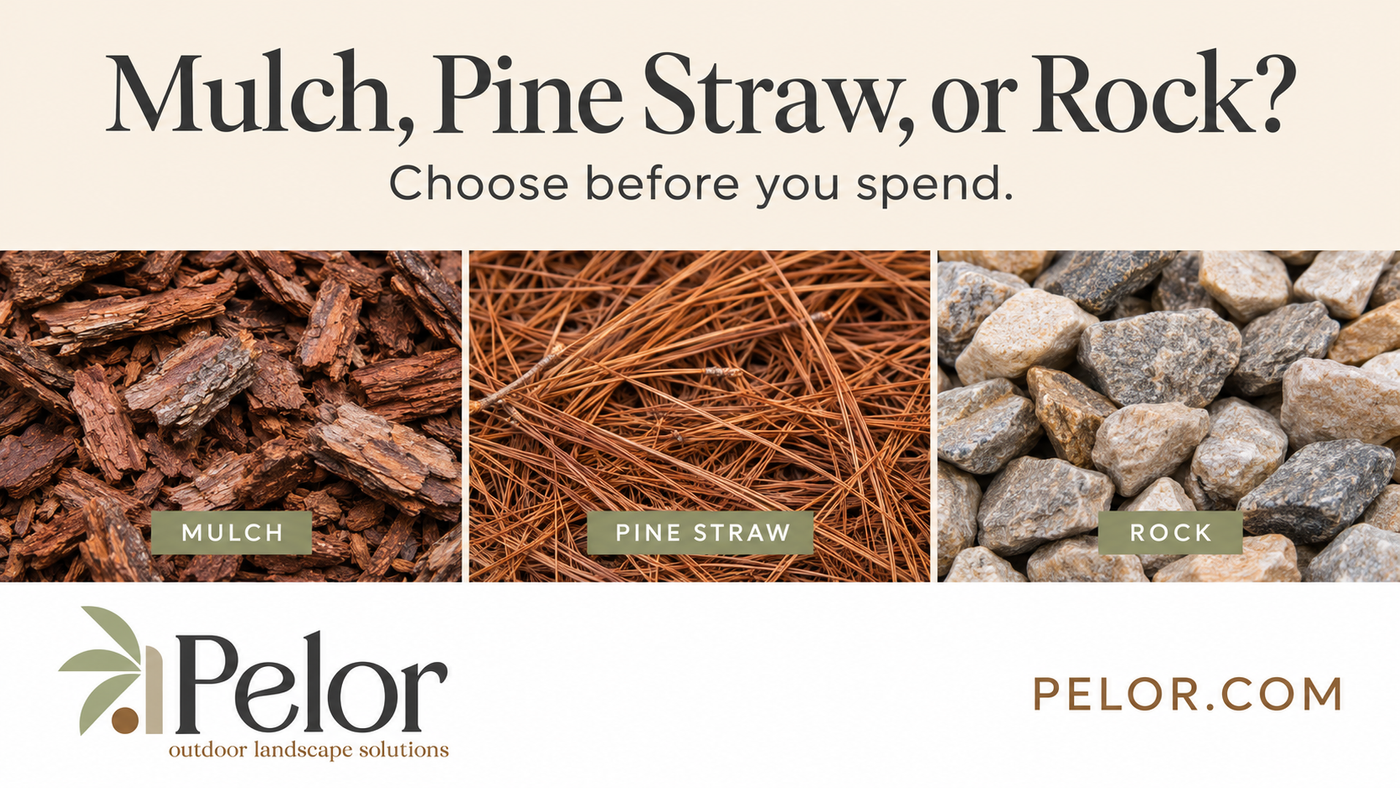
Mulch vs. Pine Straw vs. Rock: Which Fits Your Yard? Pine Bark or Wood Mulch
A practical starting point for planted landscape beds.
- Why choose it: Provides organic ground cover with a clean, finished appearance.
- Maintenance: Remove weeds, check the existing depth, and replenish as needed.
- Consider before buying: It breaks down over time, and some materials can move with runoff.
Pine Straw
A natural-looking option around established plantings.
- Why choose it: Offers a softer texture, and the needles settle and knit together.
- Maintenance: Redistribute displaced needles and replenish as needed.
- Consider before buying: Its loose appearance may not suit every entrance, walkway, or landscape style.
Decorative Rock
An option for a defined decorative area with limited planting.
- Why choose it: Creates a distinct accent and does not decompose like organic mulch.
- Maintenance: Remove fallen leaves, manage weeds, and keep stones contained.
- Consider before buying: It does not provide the soil-building benefits of organic mulch, and moving it can complicate future planting changes.
No option removes the need to maintain the space. The useful question is: Which maintenance tasks are you willing to keep doing?
Choose Organic Mulch When the Plants Come First
For shrub beds, tree beds, and other planted areas, think about the soil beneath the finish.
UF/IFAS guidance explains that organic mulch can help conserve soil moisture, moderate temperature, suppress weeds, and contribute organic matter as it decomposes. Florida-Friendly Landscaping guidance favors suitable organic mulches in planted beds.
That makes pine bark or another appropriate organic material a practical starting point when your goal is a healthy planted bed with a finished appearance.
The tradeoff is replenishment. Organic material breaks down, so its condition and depth need checking. Adding another layer every time the color fades can create excessive buildup.
Before refreshing a bed, check what is already there. Include existing material when deciding how much to add, and keep mulch off plant stems and tree trunks.
Explore Pelor Outdoor’s landscaping services if your project also involves tired shrubs, bed preparation, or selective plant replacement.
Consider Pine Straw When You Want a Natural Finish
Pine straw is made from pine needles. It belongs in the organic mulch category, but its texture creates a different look from bark or wood mulch.
UF/IFAS notes that pine needles settle and knit together, which can be useful on some sloped sites. That does not mean pine straw will correct concentrated runoff or stay in place in every storm.
Before choosing it, consider:
- Whether you like its appearance next to the home and existing plants.
- Whether the bed borders a frequently used walkway.
- Where rainwater enters and leaves the area.
- How accessible the bed will be for future replenishment.
For a front entrance or HOA monument, ask to see the proposed material in context. A close-up product photo tells you less than a sample beside the actual planting bed.
Choose Decorative Rock for a Specific Purpose
Decorative stone can create a distinct accent or finish in an appropriately designed area. It also changes the maintenance you will need to do.
Leaves and fine debris can collect between stones. Weeds still need attention. If you later change the planting layout, moving stone can become part of the project.
UF/IFAS guidance on mulching does not recommend inorganic mulch as the default cover for planted beds. It does not contribute nutrients through decomposition, and keeping it clear of dirt and leaves requires ongoing attention.
If you are considering a mulch-to-rock conversion, ask:
- Is this primarily a planting bed or a decorative area?
- How much leaf litter lands here?
- Will the border contain the selected stone?
- How will future plant or irrigation work be handled?
- What preparation and removal are included in the estimate?
Choose rock because it fits the space and your maintenance expectations. Every landscape material still needs care.
If Your Mulch Keeps Washing Away, Look at the Water First
A bare strip after rain may be telling you something about the site.
From a safe location, observe where water enters the bed:
- Does a downspout discharge into it?
- Is runoff crossing from a paved surface?
- Does material collect at the same low point?
- Is soil washing out along with the mulch?
Photograph the pattern and bring it to your assessment. Changing the surface material alone may leave the underlying issue unresolved.
Recurring washouts may call for evaluation of edging, runoff, or minor grading needs. The appropriate response depends on the property. Adding stone is not a guaranteed drainage fix.
Compare the Whole Project Before You Choose a Material
An installation estimate should identify what happens before the new material goes down.
Ask whether the scope includes:
- Measuring the work area and checking existing material depth.
- Removing unwanted vegetation and excess or unsuitable material.
- Protecting plants and identifying irrigation components.
- Repairing or defining bed borders.
- Supplying and installing the selected material.
- Hauling away debris and cleaning adjacent surfaces.
Access, preparation, disposal, and the condition of the existing bed all affect the completed project cost.
For a real example of a broader bed refresh, see Pelor’s Winter Garden landscape makeover, which combined plant removal, new plantings, and pine mulch application.
A Five-Minute Check Before You Request an Estimate
Walk to the area you want to improve and answer these questions:
- What bothers me most? Weeds, bare soil, scattered material, or the overall appearance?
- Which plants do I want to keep? Identify established plants you want protected.
- Where do leaves and rainwater collect? Look for recurring maintenance trouble spots.
- What maintenance am I trying to reduce? Be specific about the tasks taking your time.
- How much work do I want to tackle? Decide whether this is a single-bed refresh or part of a larger project.
Take one wide photo and two close-ups of problem areas. These give your landscaping provider a useful starting point, although a site visit may still be needed.
Get Help Choosing the Right Finish for Your Property
A focused landscape bed refresh can start with one clear goal: restoring the front entrance, improving a tired planting area, or refreshing an HOA monument bed.
Pelor Outdoor can help you discuss material selection, preparation, and the improvements your property needs.
For homeowners and property managers in Kissimmee, St. Cloud, Orlando, and surrounding Central Florida communities, the first step is understanding the space before choosing what goes on top.
Request a free assessment from Pelor Outdoor, or call 407-738-1146.
Tell the team which area you want to improve and what keeps making it difficult to maintain.
Frequently Asked Questions About Mulch, Pine Straw, and Rock
Is rock better than mulch in Central Florida?
It depends on the purpose of the area. Appropriate organic mulch is generally the better starting point for planted beds under Florida-Friendly Landscaping guidance. Rock may fit a decorative design, but it still requires weed management and debris removal.
Is pine straw the same as mulch?
Pine straw is one type of organic mulch. It is often compared with pine bark and wood mulch because its appearance, handling, and maintenance differ.
Will decorative rock stop weeds permanently?
No. A rock installation should not be treated as permanent weed prevention. Plan for ongoing inspection and weed management.
How deep should organic mulch be?
UF/IFAS generally recommends a settled layer of about 2 to 3 inches in landscape beds. Count the existing layer toward that depth and keep material away from the base of plants. Individual site conditions may require more specific guidance.
Can I put fresh mulch over old mulch?
Sometimes, but check the existing depth and condition first. A refresh should restore appropriate coverage without creating an excessive layer or burying plant bases.
How much does a landscape bed refresh cost in Kissimmee or St. Cloud?
The cost depends on bed size, material, access, preparation, removal, and disposal. Request an itemized scope so you can compare the same work across estimates.
Can I refresh just one landscape bed?
A single area can be the starting scope for an assessment. Ask Pelor about the work involved, availability, and any minimum project requirements before scheduling.
Should I check HOA requirements before changing materials?
Yes. Confirm any applicable community requirements before ordering a different material, changing borders, or altering the bed layout.