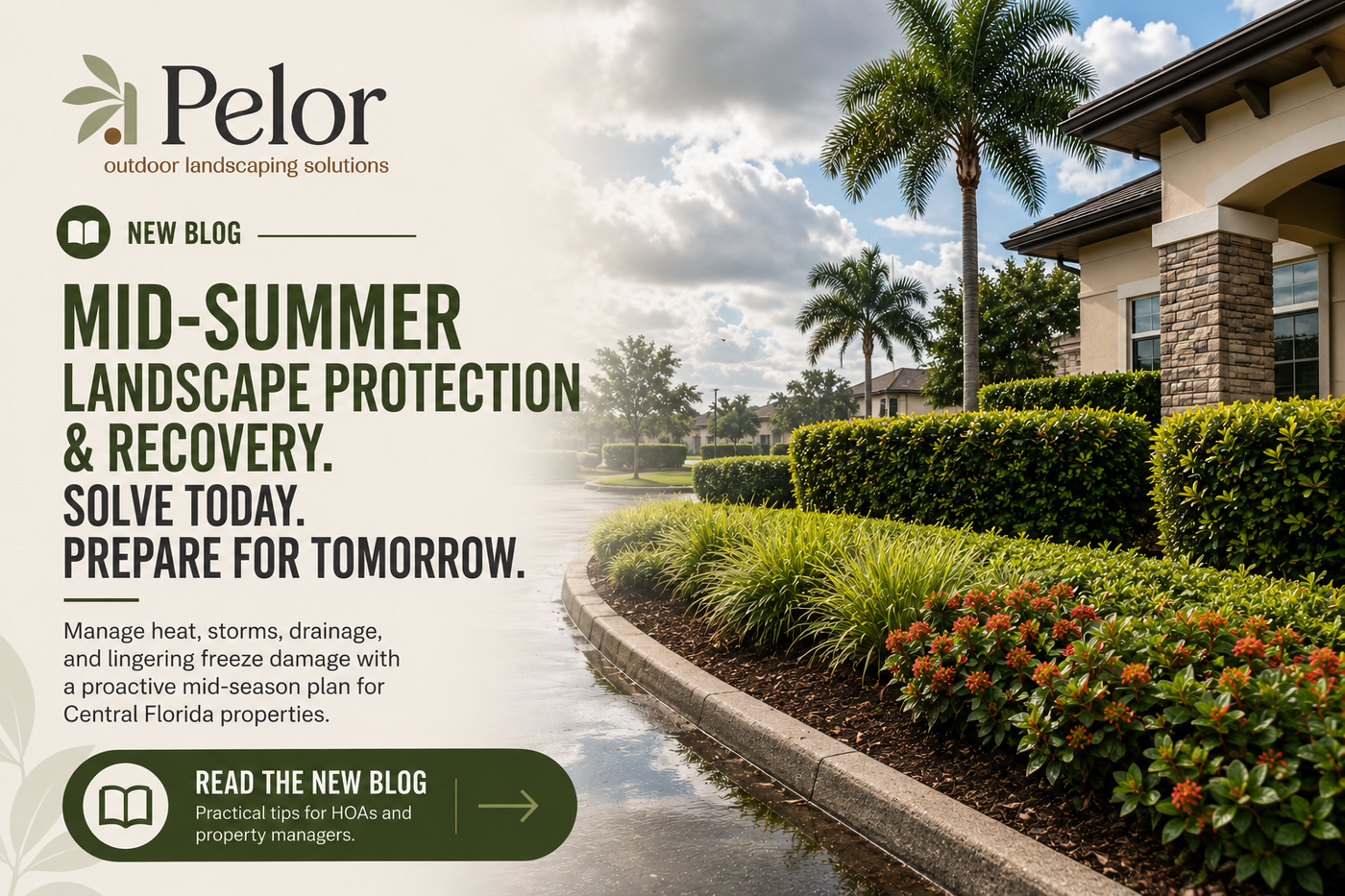
For HOA boards and commercial property managers in Orlando, Kissimmee, and throughout Central Florida, summer landscape management is not simply about keeping grass green.
By mid-summer, properties are often dealing with several pressures simultaneously: intense heat, fast turf growth, afternoon thunderstorms, saturated soils, irrigation inconsistencies, algae buildup, storm debris, and plants that may still be showing the effects of earlier cold weather.
That makes this an ideal time for a mid-season commercial landscape audit.
The goal is to solve immediate summer problems while identifying landscape weaknesses that could continue costing the property money through fall, hurricane season, and the next winter.
Key Takeaways
- Mid-summer is an important inspection point for HOA and commercial landscapes because heat stress, irrigation problems, drainage failures, storm exposure, and older cold damage can appear at the same time.
- More irrigation is not always the solution to stressed turf. Property managers should consider rainfall, soil moisture, sprinkler coverage, drainage, disease pressure, and root health before increasing watering.
- Standing water, washouts, clogged drainage paths, and repeatedly saturated turf can become larger maintenance and liability concerns during Central Florida's rainy season.
- Plants that never fully recovered from previous cold damage should be evaluated for live tissue, structural decline, root problems, and replacement potential.
- Replacing chronically struggling plants with species suited to the property's specific sun, soil, irrigation, drainage, and temperature conditions can reduce repeated maintenance costs.
- A commercial landscape partner should address the entire property, including turf, irrigation, plant material, drainage, storm readiness, entryways, walls, and perimeter areas.
Why Mid-Summer Is a Critical Time for Commercial Landscaping in Central Florida
A Central Florida landscape can experience drought-like stress and excessive rainfall within a relatively short period.
That creates a management challenge for HOA communities, multifamily properties, office campuses, retail centers, and commercial facilities. Irrigation systems may still be operating on schedules created for drier conditions while afternoon storms are already supplying substantial water.
At the same time, heat can expose areas with poor sprinkler coverage, compacted soil, weak turf, deteriorating sod, or damaged plants.
The result is that two sections of the same property can require completely different responses.
One lawn area may be drying out.
Another may be remaining saturated for too long.
One shrub bed may be growing aggressively.
Another may contain plants that never recovered properly from a previous freeze.
Effective HOA landscaping services should recognize these differences instead of applying the same maintenance approach across the entire property.
1. Balance Summer Heat, Irrigation, and Heavy Rain
How should commercial irrigation be managed during a Central Florida summer?
Commercial irrigation should respond to actual landscape conditions rather than automatically increasing run times because temperatures are high.
During rainy periods, excessive irrigation can contribute to saturated soil, weak roots, fungal pressure, runoff, and unnecessary water use. Florida-Friendly Landscaping guidance emphasizes keeping rainfall and irrigation water on the landscape where possible while reducing unnecessary stormwater runoff.
A mid-summer irrigation inspection should evaluate:
- Sprinkler coverage and dry zones
- Broken, clogged, tilted, or misaligned heads
- Overspray onto sidewalks and parking areas
- Water collecting in planting beds
- Rain sensor and controller performance
- Differences between sunny and shaded turf
- Signs of erosion around discharge areas
- Irrigation zones running after substantial rainfall
- Areas where turf remains saturated long after a storm
For larger HOA and commercial properties, irrigation problems often reveal themselves through patterns.
Repeated brown areas may indicate poor coverage rather than insufficient watering. Constantly wet areas may point to broken irrigation equipment, grading problems, compacted soil, or inadequate drainage.
Before increasing irrigation, determine why the landscape appears stressed.
Heat stress and overwatering can look similar
Brown or thinning turf does not automatically mean a lawn needs more water.
Heat stress, root problems, disease, poor soil conditions, excessive moisture, irrigation coverage gaps, and physical damage can all affect turf appearance.
That is why an experienced commercial landscaper should diagnose conditions before adjusting watering schedules or recommending replacement sod.
If turf has deteriorated beyond practical recovery, targeted sod lawn installation in Orlando, FL may provide better long-term results than repeatedly trying to restore a severely damaged section.
The important question is not simply, "How do we make this area green again?"
It is:
What caused the turf failure, and what needs to change before new sod goes down?
Otherwise, the same problem can return.
2. Identify Drainage Problems Before the Next Major Storm
What drainage problems should HOA managers look for during summer?
HOA and commercial property managers should pay attention to areas where water repeatedly pools, flows across walkways, erodes mulch or soil, saturates turf, or remains trapped near buildings and landscape beds.
Florida's heavy summer rainfall makes drainage performance easier to evaluate because problem areas become visible immediately after storms.
Warning signs include:
- Standing water after normal afternoon rainfall
- Mulch washing onto sidewalks
- Soil erosion around beds or retention areas
- Water flowing across pedestrian routes
- Turf that stays soft or saturated
- Exposed roots
- Depressions that repeatedly collect water
- Sediment accumulating around drains
- Clogged drainage paths
- Water moving toward structures instead of away from them
UF/IFAS notes that landscape features such as berms, swales, and appropriately located rain-retention areas can help slow runoff and allow rainfall to soak into the ground, depending on the site.
Not every property needs the same drainage correction.
Effective yard drainage solutions may involve correcting grading, improving drainage pathways, addressing compacted areas, modifying landscape beds, restoring eroded locations, or coordinating more specialized drainage work when needed.
For HOA boards, documenting these areas during summer also provides useful information for future capital planning.
Is your HOA or commercial property showing signs of turf stress, standing water, irrigation problems, or declining plants?
Pelor Outdoor can evaluate the landscape as a complete system instead of treating each symptom separately. A mid-season property review can help identify immediate maintenance priorities, drainage concerns, plant replacement opportunities, and storm-related vulnerabilities before they become larger expenses.
Contact Pelor Outdoor to schedule a commercial landscape evaluation in Kissimmee, Orlando, or the surrounding Central Florida area.
3. Conduct a Mid-Season Audit for Lingering Freeze Damage
Can plants still show freeze damage months after cold weather?
Yes. Some cold-damaged plants recover quickly, while others may retain dead wood, produce weak or uneven regrowth, or decline because portions of the plant were more severely injured.
This can become easier to evaluate once active growing conditions return.
UF/IFAS recommends waiting until plants begin producing new growth before determining the extent of cold injury. One assessment technique is checking beneath the bark, where damaged wood may appear brown or black rather than healthy.
By mid-summer, property managers can ask:
- Has the plant produced healthy new growth?
- Are entire branches still bare?
- Is regrowth limited to the plant's base?
- Is the canopy severely uneven?
- Does wood beneath the bark appear alive?
- Is the plant repeatedly declining despite adequate maintenance?
- Would replacement now be more economical than continued corrective maintenance?
This assessment is especially useful on commercial properties where appearance standards matter.
A shrub that technically remains alive may still fail to meet the visual expectations of an HOA entrance, clubhouse, retail frontage, office property, or community amenity.
Freeze damage versus summer scorching
Cold damage and current summer stress should not automatically be treated as the same problem.
Lingering freeze injury is more likely to show as dead stems, sections that failed to leaf back out, or uneven recovery from older wood.
Current summer stress may be associated with wilting, leaf scorch, irrigation problems, reflected heat, root-zone conditions, recent transplanting, or excessive moisture.
A professional inspection can help determine whether a plant needs corrective pruning, additional recovery time, a change in site conditions, or complete replacement.
4. Prune Damaged Plants Without Creating More Stress
Should freeze-damaged shrubs be pruned during summer?
Once the true extent of old cold damage is clear and healthy regrowth has identified living portions of the plant, dead material can often be selectively removed.
The emphasis should be on corrective pruning, not automatically cutting the entire plant back.
UF/IFAS advises delaying pruning immediately after cold damage because damaged foliage can provide protection during additional cold weather and because the boundary between living and dead tissue may not initially be obvious.
By summer, the assessment is generally clearer.
Crews should focus on:
- Dead branches
- Broken or unsafe material
- Clearly failed stems
- Growth interfering with access or visibility
- Selective shaping where appropriate
Pruning wet plants should also be approached carefully because plant diseases can spread more easily when foliage is wet. UF/IFAS recommends allowing plants to dry before pruning following periods of heavy rain.
For commercial properties, pruning decisions should balance plant health, safety, appearance, and long-term structure rather than simply creating a uniformly sheared look.
5. Replace Chronic Problem Plants With More Resilient Landscaping
Sometimes the smartest landscape maintenance decision is to stop maintaining a plant that is poorly matched to its location.
If the same shrub repeatedly suffers from cold injury, heat stress, excessive moisture, irrigation conflicts, or constant corrective pruning, replacement can reduce long-term maintenance requirements.
What are good low-maintenance shrubs for Central Florida commercial landscapes?
There is no single plant list that is ideal for every Central Florida property.
The right selection depends on:
- Sun exposure
- Soil drainage
- Irrigation availability
- Mature plant size
- Salt exposure where applicable
- Desired hedge or screening height
- Cold exposure and local microclimate
- Pedestrian and vehicle visibility
- Maintenance frequency
- HOA architectural standards
Potential Central Florida landscape selections may include plants such as Podocarpus, selected Viburnum species or cultivars, Loropetalum, and Firebush, depending on the specific planting location and design objective.
However, "cold hardy" should not be treated as an absolute label.
Central Florida contains meaningful microclimate differences. A protected planting near a building in Orlando may perform differently from an exposed section of a large Kissimmee property.
Plant selection should therefore be based on the right plant, right place principle rather than appearance alone.
Low maintenance starts with mature size
One of the simplest ways to reduce commercial landscape costs is to choose plants whose mature dimensions fit the space.
Installing a shrub that naturally wants to become much larger than the intended hedge creates an ongoing cycle of:
- Rapid growth
- Frequent shearing
- Disposal of excess plant material
- Increased labor
- Declining plant structure
- Eventual replacement
A better landscape design uses plant material that naturally fits the desired height and width.
For HOA boards reviewing annual landscape budgets, this can turn plant replacement from a cosmetic expense into a long-term maintenance optimization strategy.
6. Use Mid-Summer Replacements to Future-Proof the Property
A landscape renovation does not need to involve replacing an entire property at once.
Strategic upgrades can target the sections creating the greatest maintenance burden.
Good candidates include:
- Repeatedly freeze-damaged shrubs
- Plants blocking signage
- Overgrown foundation plantings
- High-maintenance hedges
- Plants located beneath roof drainage
- Shrubs continually damaged by irrigation
- Beds with chronic drainage problems
- Declining entrance landscaping
- Plants creating visibility issues at intersections
- Sections that require frequent replacement
A commercial landscape plan can gradually replace these weak points with more appropriate plant material.
That creates a property that becomes easier to maintain each year instead of accumulating more maintenance problems.
7. Prepare Trees, Landscapes, and Common Areas for Summer Storms
Mid-summer landscape management in Central Florida also overlaps with hurricane-season preparation.
HOA boards and commercial facility managers should inspect properties for conditions that could create problems during strong storms.
Areas to review include:
- Dead or hanging tree limbs
- Weak branches over walkways or parking areas
- Loose landscape debris
- Clogged drainage routes
- Eroded planting areas
- Unsecured landscape materials
- Weak or deteriorating perimeter vegetation
- Areas prone to flooding
- Newly installed trees requiring staking evaluation
- Landscape material obstructing stormwater flow
A proactive inspection is different from commercial storm cleanup.
Storm cleanup is reactive.
Storm preparation attempts to reduce preventable problems before severe weather arrives.
Properties should also have a clear post-storm inspection process so safety concerns, blocked access, fallen material, irrigation damage, and drainage problems can be identified quickly.
8. Do Not Ignore Hardscapes, Walls, and Perimeter Areas
Healthy plants are only one part of commercial curb appeal.
Central Florida's heat, moisture, and frequent rainfall can contribute to algae and organic buildup on shaded hardscape surfaces, walls, curbs, fencing areas, and community entry features.
By mid-summer, property appearance can decline even when turf and shrubs are being maintained regularly.
A commercial property review should include:
- Community entryways
- Monument signs
- Sidewalk edges
- Curbs
- Retaining wall areas
- Dumpster enclosures
- Fence lines
- Gates
- Common-area hardscapes
- High-visibility amenity areas
Pressure washing or surface cleaning can help restore presentation where appropriate.
Fence lines should also be inspected for vegetation interference, leaning sections, corrosion or deterioration, storm exposure, and access issues.
If repair or replacement extends beyond landscape maintenance, a property may need to coordinate with qualified Orlando commercial fence contractors or Kissimmee commercial fence contractors.
The larger objective is consistency.
A professionally maintained landscape loses much of its impact if the entrance wall, fence line, or hardscape immediately beside it appears neglected.
What Should Be Included in a Mid-Summer HOA Landscape Audit?
For HOA boards and commercial property managers, a practical mid-season inspection should review the entire exterior environment.
Turf
Check for heat stress, thinning, disease symptoms, irrigation gaps, erosion, and areas where sod replacement may be necessary.
Irrigation
Test zones, sprinkler heads, controllers, rainfall response, coverage, overspray, and obvious leaks.
Drainage
Document standing water, erosion, runoff patterns, clogged routes, saturated turf, and recurring trouble spots.
Trees and Shrubs
Identify dead wood, storm hazards, freeze-related decline, excessive growth, visibility concerns, and plants that may be better replaced.
Landscape Beds
Evaluate mulch depth, weeds, drainage, plant spacing, erosion, and maintenance requirements.
Storm Readiness
Look for loose debris, dead limbs, drainage restrictions, and vulnerable property areas.
Hardscape and Perimeter Areas
Inspect sidewalks, entrances, walls, fence lines, signage areas, and other high-visibility surfaces for buildup or maintenance concerns.
Long-Term Upgrades
Identify areas where replacing high-maintenance plant material could improve appearance while lowering future maintenance demands.
The Business Case for Proactive Commercial Landscape Maintenance
For an HOA or commercial property, landscaping is not simply an appearance expense.
It affects the property's presentation, resident or tenant experience, maintenance planning, infrastructure visibility, pedestrian access, storm readiness, and long-term operating costs.
Reactive maintenance often creates repeated service cycles:
A problem appears → a temporary correction is made → the underlying cause remains → the problem returns.
A proactive commercial grounds strategy works differently:
Inspect → diagnose → correct the cause → improve the landscape system → monitor results.
That is the difference between simply maintaining vegetation and actively managing a property.
For HOA boards comparing HOA landscaping companies, this distinction matters.
The lowest-cost maintenance schedule is not necessarily the lowest-cost landscape over several years.
A partner who recognizes irrigation inefficiency, poor plant selection, drainage trouble, recurring turf failure, or developing storm hazards may prevent significantly larger maintenance problems later.
Commercial Landscaping for Orlando, Kissimmee, and Central Florida Properties
Pelor Outdoor works with commercial properties and communities that need more than routine mowing and trimming.
Our approach is centered on identifying what the property needs now while helping owners and managers plan for what comes next.
For properties seeking commercial property landscaping in Orlando, FL, Kissimmee commercial landscaping, or professional HOA landscaping services throughout Central Florida, mid-summer is an ideal time to evaluate:
- Irrigation performance
- Turf condition
- Drainage concerns
- Storm readiness
- Tree and shrub health
- Lingering freeze damage
- Plant replacement opportunities
- Low-maintenance landscape upgrades
- Common-area appearance
- Long-term maintenance priorities
Request a commercial landscape evaluation from Pelor Outdoor and build a stronger plan for the remainder of summer, hurricane season, and the months ahead.
Frequently Asked Questions
What should HOA landscaping services include during summer in Central Florida?
Summer HOA landscaping should include turf maintenance, irrigation monitoring, shrub and tree care, weed management, drainage observation, storm preparation, and regular inspection for heat stress or excessive moisture. Larger properties should also review high-traffic common areas, entrances, retention areas, and recurring landscape trouble spots.
How often should a commercial irrigation system be inspected during the summer?
Irrigation performance should be monitored regularly throughout the growing season, particularly after major weather changes, landscape renovations, or noticeable turf decline. A system can appear operational while still containing clogged heads, poor coverage, overspray, leaks, or incorrectly scheduled zones.
Can too much rain damage a commercial landscape?
Yes. Repeated saturation can reduce oxygen around roots, contribute to plant decline, increase disease pressure, cause erosion, move mulch and soil, and expose weaknesses in property drainage. UF/IFAS recommends proactive management after heavy rains, including keeping debris clear and avoiding unnecessary practices that can worsen plant stress.
How can I tell if a shrub has permanent freeze damage?
Branches that fail to produce new growth after the landscape has returned to active growth may be damaged. Checking beneath the bark can also help identify living versus injured wood. UF/IFAS notes that cold-injured tissue may appear brown or black beneath the bark.
Should freeze-damaged plants always be replaced?
No. Some plants recover successfully once damaged material is properly identified and removed. Replacement becomes more attractive when a plant has severe structural decline, repeatedly suffers from site conditions, no longer meets property appearance standards, or requires excessive maintenance to remain presentable.
What are some cold-hardy plants for Central Florida?
Plant selection depends heavily on the individual property. Podocarpus, certain Viburnums, Loropetalum, Firebush, and other Florida-adapted plants may work in appropriate locations, but sun exposure, irrigation, drainage, mature size, and local cold exposure should all be evaluated before installation. A plant that performs well in one Central Florida microclimate may struggle in another.
What are the best low-maintenance shrubs for Central Florida commercial properties?
The best low-maintenance plants are those whose natural mature size and environmental requirements fit the planting area. Choosing a shrub that fits its available space reduces the need for frequent shearing and corrective pruning. Site-specific plant selection is more important than choosing from a generic list of "low-maintenance" species.
When should damaged commercial sod be replaced?
Sod replacement should be considered when turf has deteriorated beyond reasonable recovery or when damaged areas are affecting property appearance or function. Before installing new sod, however, determine whether irrigation, drainage, shade, soil conditions, pests, disease, or traffic caused the original failure.
What are common signs that a commercial property needs drainage improvements?
Repeated standing water, washed-out mulch, eroded soil, saturated turf, water crossing sidewalks, sediment accumulation, and areas that remain wet long after rainfall are common warning signs. The correct solution depends on grading, soil conditions, stormwater infrastructure, irrigation, and the location of the affected area.
Why should an HOA schedule a mid-summer landscape inspection?
A mid-summer inspection allows an HOA to evaluate heat stress, irrigation efficiency, drainage performance, storm readiness, turf condition, plant health, and old freeze damage at the same time. It also gives the board an opportunity to identify potential fall improvements and budget priorities before problems become more expensive.
Does Pelor Outdoor provide commercial landscaping in Orlando and Kissimmee?
Pelor Outdoor serves commercial and HOA properties in Kissimmee, Orlando, and the broader Central Florida market. Property managers can request an evaluation to identify immediate landscape maintenance needs and longer-term opportunities involving irrigation, turf, drainage, plant health, storm preparation, and landscape improvements.