
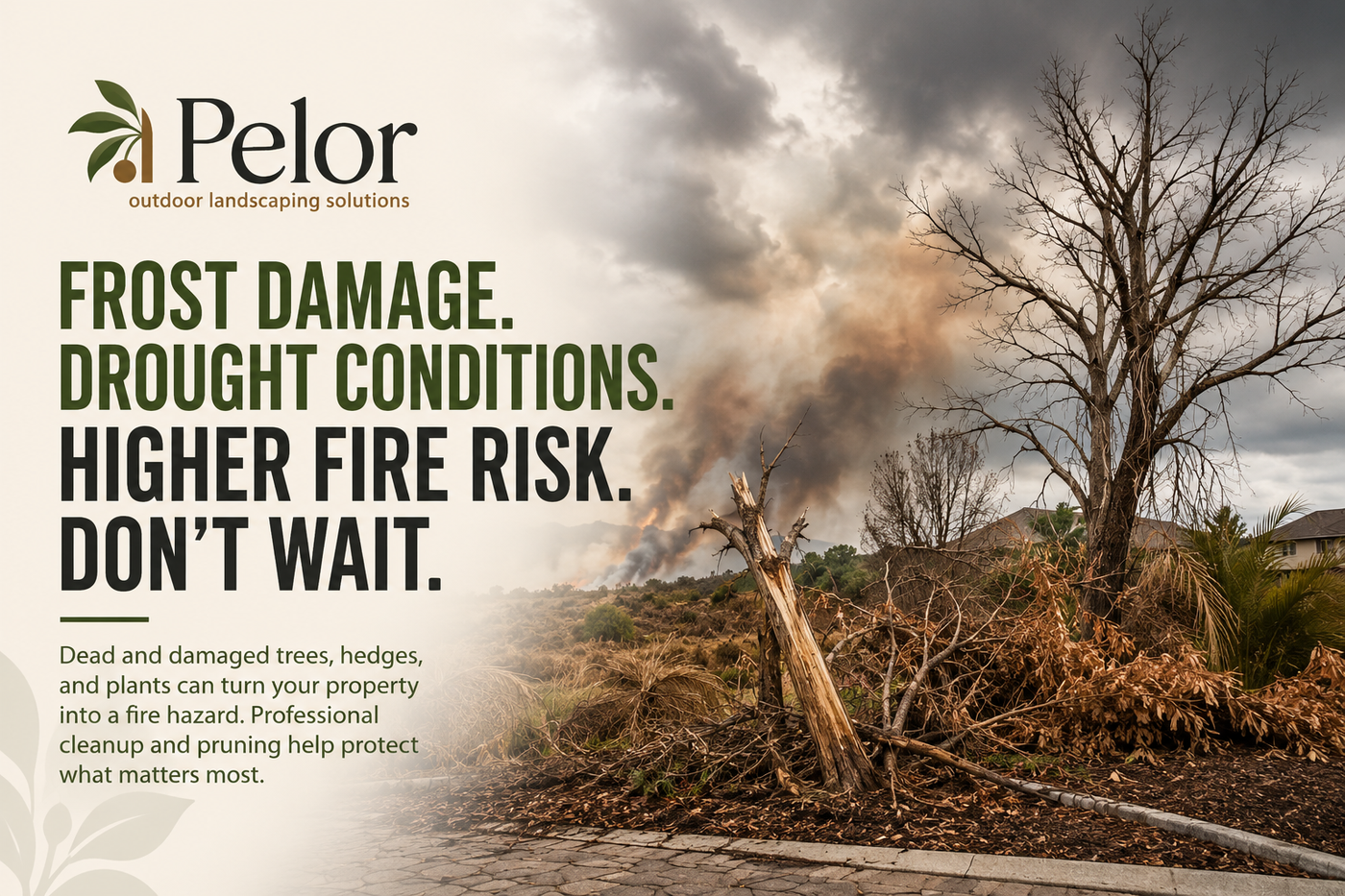
Heavy summer rain does not eliminate Central Florida brushfire risk. Learn how dead frost-damaged hedges, trees, and plants can threaten residential, HOA, and commercial properties.
Key Takeaways
Heavy summer rain can improve surface moisture without fully eliminating drought conditions, deeper soil dryness, or pockets of combustible vegetation.
Frost-damaged hedges, shrubs, trees, palms, and ornamental plants can become dry fuel when dead material remains in the landscape.
Lightning from Central Florida thunderstorms can create additional ignition risk, especially where dead vegetation has accumulated near buildings, fences, utility areas, and natural spaces.
Delaying cleanup to avoid an immediate landscaping expense can expose a property to much larger costs, including fire damage, emergency tree work, property repairs, business interruption, and insurance complications.
Residential, HOA, multifamily, and commercial properties should schedule a professional landscape risk inspection and remove confirmed dead material before it becomes a larger safety concern.
Frost-damaged plants should not always be cut immediately after a freeze. However, once warm-season growth confirms which sections are dead, leaving that material indefinitely creates unnecessary property risk.
Why Central Florida Property Owners Should Not Assume the Rain Has Eliminated Fire Risk
After weeks of summer thunderstorms, standing water, humid mornings, and fast-growing lawns, it may seem impossible that Central Florida could still face drought or brushfire concerns.
Unfortunately, rainfall does not affect every part of the landscape equally.
One neighborhood may receive several inches of rain while another area a few miles away receives very little. Even within the same property, turfgrass may look green while dead hedge interiors, elevated palm fronds, tree canopies, mulch beds, leaf piles, and vegetated areas along property lines remain dry.
The Florida Forest Service explains that Florida rainfall can vary significantly over short distances because much of it comes from localized thunderstorms. A nearby rain gauge can receive substantially more precipitation than surrounding properties, which means regional rainfall totals may not represent the actual moisture conditions on a specific site. The agency also notes that wildfire danger depends on several factors, including soil and vegetation dryness, temperature, wind, relative humidity, and atmospheric conditions.
The U.S. Drought Monitor released on July 16, 2026, based on conditions through July 14, showed that drought and abnormal dryness remained present in parts of Florida even after periods of heavy rainfall. Its weekly summary noted that recent rain improved some short-term conditions while longer-term drought effects remained in parts of the region.
That distinction matters for homeowners, HOA boards, community managers, and commercial property owners.
A wet lawn does not automatically mean the entire property is free of combustible landscape material.
Dead plants do not recover their moisture content simply because healthy turf nearby received rain. Hollow stems, dead hedge branches, suspended palm material, dried vines, fallen limbs, leaf piles, and frost-killed shrubs can continue to function as fuel once surface moisture evaporates.
Can Brushfires Still Happen After Heavy Rain?
Yes. Brushfires can still occur after heavy rain, particularly when rainfall is inconsistent, vegetation dries quickly between storms, or longer-term drought conditions remain.
Summer rainfall can reduce immediate fire danger, but Central Florida’s heat can rapidly dry exposed plant material. Sun, wind, high temperatures, and gaps between storms can remove moisture from dead vegetation much faster than from living, actively hydrated plants.
Fire risk is also highly localized.
A property may contain several different moisture environments:
Irrigated turf around the main entrance
Dry hedges beneath roof overhangs
Dead branches inside otherwise green shrubs
Leaf buildup behind buildings or along fences
Unmaintained vegetation beside retention ponds
Dry material under oak trees
Dead palm fronds suspended above ground
Frost-damaged ornamentals in shaded beds
Brush along wooded boundaries
Storm debris stored in rear service areas
The Florida Forest Service uses a Fire Danger Index to estimate the potential for a fire to start and require suppression. The agency emphasizes that conditions must be evaluated continuously because fire danger changes with rainfall, wind, humidity, temperature, and fuel conditions.
Property owners should therefore avoid relying on a simple assumption such as, “It rained yesterday, so there is no fire risk.”
A more useful question is:
How much confirmed dead and dry vegetation is still present on the property, and how close is it to something that could be damaged?
How Winter Frost Damage Can Become Summer Fire Fuel
Central Florida’s winter frost and freeze events can leave behind more damage than many property owners initially realize.
Immediately following a freeze, affected plants may show:
Brown, bronze, or black leaves
Wilted foliage
Soft or collapsed stems
Bark discoloration
Leaf drop
Dead branch tips
Entire sections of hedge dieback
Damaged palm fronds
Top growth that never returns
Plants that appear alive at the base but are dead above it
UF/IFAS advises property owners not to rush into heavy pruning immediately after a freeze. Damaged foliage can temporarily insulate lower plant tissue, and the full extent of injury may not be visible until new growth begins. Once plants start growing again, dead wood can be identified more accurately and pruned back appropriately.
That is sound recovery guidance during winter and early spring.
It is not a reason to leave confirmed dead material in place throughout the summer.
By this point in the growing season, surviving plants should generally be showing new growth. Branches, shrubs, hedge sections, and ornamentals that remain brittle, hollow, brown, or completely inactive should be evaluated.
Once material is confirmed dead, it no longer provides the same recovery benefit. It may instead become:
A source of dry fuel
A hiding place for pests
A contributor to disease pressure
A visibility problem near entrances and sidewalks
A falling-branch hazard
A code or HOA appearance concern
An obstruction around mechanical equipment
A pathway through which fire can move across a landscape
For properties that still contain extensive frost damage, the issue is no longer only cosmetic.
It is now a maintenance, liability, and property-protection concern.
Why Dead Hedges Can Be Especially Dangerous
Hedges deserve particular attention because they are often planted close to buildings, fences, parking lots, signs, utility equipment, and neighboring properties.
A hedge may appear green from the outside while containing a dense network of dead branches inside. This is common after stress from frost, improper pruning, drought, disease, shade, overcrowding, or irrigation problems.
That concealed interior material can remain dry because:
Rainwater may be intercepted by the outer canopy.
Roof overhangs may shield part of the hedge.
Dense growth can prevent moisture from penetrating evenly.
Dead branches do not transport water.
Leaf litter can accumulate beneath the plant.
Irrigation heads may be blocked or poorly aimed.
Repeated exterior shearing can hide declining interior growth.
This creates a potential fuel corridor directly beside the structure.
For a home, that may mean dry vegetation near siding, windows, soffits, screened enclosures, wooden fences, propane equipment, or outdoor furniture.
For a commercial property, it may mean dead material near electrical panels, loading areas, HVAC equipment, dumpsters, monument signs, employee smoking areas, parked vehicles, or emergency access routes.
For an HOA or multifamily community, continuous hedge rows can connect multiple buildings, common areas, conservation boundaries, and parking zones.
A professional landscape inspection should examine both the visible exterior and the interior structure of the hedge.
Lightning Adds Another Layer of Risk During Central Florida Storm Season
Central Florida’s summer thunderstorms bring heavy rain, strong wind, and frequent lightning. Rain may lower fire danger in some locations, but lightning is also a natural ignition source.
The National Weather Service states that lightning occurs most often during the summer and that thunderstorms can produce dangerous strikes beyond the area where rain is currently falling.
The National Weather Service also recognizes that lightning-producing storms can cause isolated or scattered lightning-induced fires under favorable conditions.
Not every lightning strike creates a visible fire immediately.
A strike can affect:
Trees
Palm crowns
Wooden fences
Utility areas
Mulch beds
Dead brush
Dry vegetation beneath tree canopies
Organic debris accumulated near buildings
Natural areas bordering developed properties
In some cases, smoldering material may not become obvious until after the storm has moved away and the rain has stopped.
Lightning is not the only possible ignition source. Property owners should also consider:
Discarded cigarettes
Landscaping equipment
Vehicle heat
Electrical faults
Outdoor cooking
Fire pits
Sparks from maintenance work
Improper debris burning
Fireworks
Adjacent wildland or brush fires
The Florida Forest Service identifies escaped debris burning as one of the leading causes of wildfires in Florida. It also regulates certain outdoor burning activities and requires authorization for activities such as land-clearing burns, acreage burns, and large pile burns.
For most residential and commercial landscape cleanup projects, hauling and legally disposing of dead vegetation is safer and more predictable than attempting to burn it.
The Cost of Delaying Frost-Damage Cleanup
It is understandable that property owners delay landscape work because of budget pressure.
Removing damaged hedges, replacing plants, pruning trees, grinding stumps, hauling debris, and restoring irrigation can require a meaningful investment. Commercial and HOA properties may also need board approval, multiple proposals, reserve funding, or revised annual budgets.
However, postponing necessary work does not remove the cost. It often transfers the cost into a higher-risk category.
Possible financial consequences of delayed cleanup include:
1. Fire damage
Even a small vegetation fire can damage fences, irrigation controls, low-voltage lighting, vehicles, signs, paint, siding, roof components, landscape beds, and nearby healthy plants.
2. Emergency response and emergency tree work
Routine pruning and planned removal are usually more manageable than emergency work performed after a fire, lightning strike, storm, or branch failure.
3. Insurance complications
Insurance policies, claim circumstances, maintenance documentation, and coverage decisions vary. Property owners should review their policies with a qualified insurance professional. Regardless of coverage, documented preventive maintenance can demonstrate that known hazards were being addressed.
4. Business interruption
A fire near a commercial entrance, parking area, loading zone, or utility system can disrupt customers, tenants, employees, vendors, and normal operations.
5. HOA and community liability
Dead vegetation in common areas may affect multiple residents. Delayed action can also create disputes over maintenance standards, reserve spending, appearance, access, and responsibility.
6. Higher replacement costs
A partially damaged hedge may be recoverable with selective pruning. Left unmanaged, stress, pests, disease, and poor irrigation coverage may cause the remaining plants to decline.
7. Storm-related debris
Dead branches and weakened plants are more likely to break during summer thunderstorms or tropical weather. Material that is already dead before a storm can become scattered debris afterward.
The lowest-cost strategy is not always the one with the smallest invoice today.
The better strategy is the one that reduces the property’s total exposure over time.
What Residential Property Owners Should Inspect
Homeowners should walk the property and look for dead vegetation within landscape beds, around structures, and near neighboring properties.
Pay close attention to:
Hedges touching or nearly touching the home
Frost-damaged shrubs beneath windows
Dead branches over roofs or screened enclosures
Palm fronds resting on roofs or fences
Leaf buildup under decks and porches
Dry vegetation around outdoor air-conditioning equipment
Plants blocking irrigation coverage
Dead vines attached to fencing
Brush behind sheds
Vegetation near propane tanks or generators
Woody debris along wooded property boundaries
Dead plants stored in piles for future disposal
Mulch or leaves against wooden structures
Do not attempt to remove large branches near power lines, climb damaged trees, or perform work requiring specialized equipment without qualified help.
For a broader property review, visit our residential landscape maintenance page or request a landscape inspection.
What HOA and Commercial Property Managers Should Inspect
Larger properties require a systematic inspection rather than a quick visual review from the road.
Commercial, HOA, apartment, condominium, hospitality, retail, and industrial sites should review:
Building perimeters
Continuous hedge lines
Rear service corridors
Retention pond edges
Conservation-area boundaries
Vacant sections of the property
Utility easements
Transformer and generator areas
Dumpster enclosures
Smoking areas
Wooden fences
Parking islands
Monument signs
Loading zones
Fire lanes
Emergency access routes
Areas hidden from routine customer view
Tree canopies above roofs and parking areas
Irrigation zones with repeated dry spots
Areas where landscape crews store or stage debris
A property may look well maintained from the main entrance while still containing substantial dead material behind buildings or along perimeter areas.
Managers should document concerns with photographs, property maps, and clear work priorities. Large projects can then be divided into phases based on risk.
Learn more about commercial landscape maintenance, HOA landscape services, and storm preparation services.
How to Prioritize Cleanup When the Budget Is Limited
Not every dead plant creates the same level of urgency.
When funds are limited, prioritize work based on proximity, fuel volume, ignition exposure, and potential consequences.
Priority 1: Immediate structure and life-safety concerns
Address dead vegetation that is:
Touching buildings
Blocking exits or access routes
Near electrical equipment
Near generators or fuel sources
Below damaged tree limbs
Along fire lanes
Near occupied outdoor spaces
Close to neighboring structures
Priority 2: Continuous fuel pathways
Break up dense stretches of dead vegetation that could allow fire to move from a natural area or property boundary toward buildings.
Examples include continuous hedge rows, brush-covered fences, connected mulch beds, and dead vines.
Priority 3: Large fuel accumulations
Remove piles of branches, palm fronds, storm debris, leaves, and previous pruning waste.
Priority 4: Irrigation and plant-health problems
Correct broken heads, blocked spray patterns, leaks, poor scheduling, and coverage gaps that are contributing to ongoing plant stress.
Priority 5: Replacement and appearance upgrades
Once immediate hazards are addressed, replace failed plants, restore bed design, install appropriate mulch, and select more resilient species.
This phased approach allows property owners to reduce the most serious exposure first without waiting for the budget to replace every damaged plant at once.
What Does a Professional Frost-Damage and Fire-Risk Landscape Inspection Include?
A useful inspection should go beyond identifying brown plants.
It should evaluate:
Plant viability: Which plants are dead, partially alive, or likely to recover?
Fuel accumulation: Where are dead leaves, limbs, fronds, and woody debris concentrated?
Proximity to structures: Which materials are closest to buildings, fences, equipment, or vehicles?
Tree condition: Are dead limbs, cracked branches, cavities, or storm weaknesses present?
Irrigation performance: Are dry areas caused by drought, blocked heads, broken components, or poor scheduling?
Drainage and erosion: Is runoff reaching some areas while bypassing others?
Access: Can emergency personnel, maintenance teams, and equipment reach critical parts of the property?
Ongoing maintenance needs: What pruning, cleanup, replacement, and monitoring schedule is appropriate?
Phasing: Which tasks should happen immediately, within 30 days, or during the next budget cycle?
Documentation: Can the property owner receive photos, recommendations, and a clearly defined scope of work?
Pelor Outdoor provides landscape assessments for residential, HOA, and commercial properties throughout Kissimmee and Central Florida. A site-specific review can help determine which plants need removal, which may be recoverable, and where dead vegetation is creating avoidable exposure.
Schedule a property inspection before summer storm activity and peak vegetation growth make existing problems harder to manage.
How Fire-Safe Landscaping Supports Long-Term Property Protection
Fire-safe landscaping does not mean removing every plant or creating a bare property.
The goal is to reduce unnecessary fuel, maintain healthy vegetation, and prevent combustible material from creating an uninterrupted path toward buildings.
The Florida Forest Service recommends reducing accumulated vegetation and creating defensible space around structures as part of wildfire preparation.
For Central Florida properties, practical steps may include:
Removing confirmed dead plants
Pruning dead interior hedge branches
Removing dead tree limbs
Separating dense plant masses
Keeping vegetation away from structures
Cleaning leaves from roofs and gutters
Removing vines from fences and buildings
Maintaining irrigation coverage
Avoiding large piles of pruning debris
Selecting plants appropriate for the site
Monitoring trees after lightning and wind events
Scheduling routine landscape inspections
Maintaining clear access for emergency and service vehicles
Landscape maintenance should be treated as part of property protection, not only appearance.
Healthy landscapes can support curb appeal, property value, shade, privacy, erosion control, and community identity. Proper maintenance also helps reduce preventable hazards before they become emergencies.
What Should You Do After Lightning Strikes a Tree?
A lightning-struck tree may not fail immediately.
Signs of possible lightning damage include:
Split bark
A vertical scar along the trunk
Missing bark
Broken limbs
Sudden leaf wilt
Scorched foliage
Hanging branches
Cracks near major unions
Soil disturbance near the root zone
Smoke, heat, or a burning smell
Damage to nearby irrigation or electrical components
Keep people and vehicles away from the area if there is any concern about fire, hanging limbs, or tree instability.
Call 911 immediately if you see smoke, flames, or an active fire. The Florida Forest Service directs wildfire emergencies to 911 or the appropriate local forestry office.
After the immediate danger has passed, have the tree assessed by an appropriately qualified tree professional. Do not assume that a tree is safe simply because it remains standing.
Frequently Asked Questions
Are we really still in a drought after so much rain?
Parts of Florida can remain under drought or abnormal dryness even after periods of heavy rain. Drought includes longer-term soil, groundwater, streamflow, and ecological conditions, not only rainfall from the most recent storm. Rainfall can also vary dramatically between nearby Central Florida neighborhoods.
Can wet vegetation still catch fire?
Living, well-hydrated vegetation is generally less receptive to ignition than dead, dry vegetation. However, rain may only wet the exterior of dense brush, hedges, mulch, or debris piles. Dead interior branches and elevated material can dry again quickly.
Does frost-damaged landscaping really increase brushfire risk?
Confirmed dead plant material can contribute fuel to a fire. The amount of risk depends on how much material exists, how dry it is, where it is located, and whether ignition sources are nearby. Dead hedges, branches, vines, fronds, and debris near buildings deserve prompt attention.
Should frost-damaged plants be removed immediately after a freeze?
Not always. UF/IFAS recommends waiting until new growth helps reveal the full extent of damage before performing major pruning. Once the plant’s condition is clear and sections are confirmed dead, that material can be removed using proper pruning practices.
How do I know whether a frost-damaged branch is dead?
A dead branch may be brittle, dry, hollow, discolored beneath the bark, and completely absent of new growth. A professional assessment is recommended for valuable shrubs, large trees, palms, or uncertain cases.
Can lightning start a brushfire during a rainstorm?
Yes. Lightning can ignite trees and vegetation, and fires can sometimes smolder before becoming obvious. Risk depends on fuel dryness, rainfall intensity, wind, and the location of the strike.
Is it safe to burn dead landscape debris?
Outdoor burning is regulated, and certain activities require authorization. Escaped debris burning is one of Florida’s leading wildfire causes. Check all state and local rules before burning. Professional hauling and disposal may be the safer choice.
What areas of a commercial property should be inspected first?
Start with building perimeters, electrical equipment, generators, loading areas, dumpsters, smoking areas, fire lanes, property boundaries, retention ponds, wooden fences, and locations containing piles of dead vegetation.
Can cleanup be completed in phases?
Yes. Begin with material closest to structures, utilities, occupied areas, and potential ignition sources. Next, remove continuous fuel pathways and large debris accumulations. Replacement planting and cosmetic improvements can follow.
Does irrigation eliminate brushfire risk?
No. Irrigation can support plant health and reduce landscape stress, but it does not reach every part of a property. Dead branches, elevated fronds, leaf piles, woody debris, roof areas, and vegetation outside irrigated zones may remain dry.
How often should an HOA or commercial property receive a landscape risk inspection?
Properties should be reviewed after freezes, lightning strikes, severe storms, hurricanes, major pruning, irrigation failures, or visible plant decline. A formal seasonal inspection is also useful before summer storms and hurricane season.
Who should I call if I see an active brushfire?
Call 911 immediately. Do not attempt to control a spreading vegetation fire yourself.
Protect the Property Before a Manageable Cleanup Becomes an Emergency
Central Florida’s summer rain can create a false sense of security.
Green grass and afternoon storms do not erase every drought condition, and they do not automatically remove the dead landscape material left behind by winter frost. When dry hedges, dead trees, damaged shrubs, palm fronds, vines, and accumulated debris remain close to homes, businesses, community buildings, and utility areas, they create an avoidable layer of risk.
The immediate cost of cleanup may feel inconvenient.
The cost of a fire, emergency removal, damaged structure, interrupted business, insurance claim, or community-wide incident can be far greater.
Pelor Outdoor helps homeowners, HOA communities, and commercial property managers identify frost damage, remove dead vegetation, improve irrigation performance, prepare for storms, and build a safer long-term landscape maintenance plan.
Do not wait for smoke, a lightning strike, or the next dry stretch to expose a problem that is already visible.
Request a Central Florida landscape inspection today or explore our landscape maintenance services to begin prioritizing the areas that need attention most.